When you first delve into DNA testing, it is tempting to think your own results are the final word. However, as any seasoned researcher will tell you, the key to unlocking the deep past often lies in the DNA of our relatives.
Managing multiple kits can feel overwhelming, but with a bit of planning, you can turn your family’s collective data into a powerful research tool.
Who Should You Test?
If you have a limited budget, you’ll need to be strategic about whose DNA you invite into your research.
- The Eldest Generations First: This is the most critical rule of genealogy. Your parents, grandparents, or great-aunts and uncles carry segments of DNA that you didn’t inherit. Testing them is like reaching back a generation in time.
- Targeted Testing for ‘brick walls’: If you are stuck on a specific line, perhaps a mysterious great-grandfather, test his direct descendants or his siblings’ descendants.
- Siblings: Even though you share the same parents, you and your siblings inherited different segments of DNA. Their matches might include a cousin who doesn’t show up on your list at all.
Unlocking Direct Lines: The Benefits of Y-DNA and mtDNA
Standard autosomal testing (like Ancestry or 23andMe) is brilliant for finding cousins across all your branches, but after a few generations, the DNA from a specific ancestor can disappear entirely. This is where testing specific relatives for Y-DNA and mtDNA can prove to be a game-changer for your research.
Y-DNA: Tracing the Paternal Surname
Y-DNA is passed strictly from father to son, virtually unchanged, for hundreds of years. This makes it an incredible tool for breaking through ‘brick walls’ on your direct paternal line.
- The Benefit: If you are researching a specific surname,testing a direct male descendant of that line can prove whether you share a common patrilineal ancestor with other families of the same name.
- Who to Test: A father, brother, paternal uncle, or a male cousin who shares your father’s surname.
mtDNA: The Unbroken Maternal Link
Mitochondrial DNA (mtDNA) is passed from a mother to all her children, but only the daughters pass it on. It tracks your direct ‘umbilical’ line back thousands of years.
- The Benefit: Because surnames change every generation on the maternal side, records often go cold. mtDNA allows you to find matches who share that same ancient maternal origin, helping you to verify links when paper records like marriage certificates are missing.
- Who to Test: Yourself (anyone can take this test), your mother, your maternal aunt, or any cousin descended from your mother’s mother through an unbroken female line.
X-DNA: The Hidden Filter
While most people focus on autosomal DNA, X-DNA is a unique tool that follows very specific inheritance patterns. Because it isn’t passed down from every ancestor, it acts as a filter that can instantly rule out certain branches of your tree.
- The Inheritance Rule: Men only inherit one X chromosome (from their mother), while women inherit two (one from each parent). A man will never pass his X-DNA to his son.
- The Benefit: If you are a male researcher and you find a match on GEDmatch with shared X-DNA, you know immediately that the connection must be on your mother’s side.
- Targeted Research: By using the X-DNA inheritance charts, you can pinpoint exactly which “fan” of ancestors could have passed that DNA to you, saving you from searching through half your tree.
Why These Matter for Your GEDmatch Research
When you find a match on GEDmatch, knowing their Y-DNA or mtDNA haplogroup can instantly tell you which side of the family they are on.
If you find a second cousin with a kit number and you notice they share your specific Y-DNA haplogroup, you’ve immediately narrowed that match down to your father’s direct paternal line. It saves hours of guesswork!
When you record a relative’s details in your DNA Research Log, use the ‘Notes’ section to jot down their haplogroups. It acts as a permanent ‘signpost’ for your future research.
Tips for Managing Multiple DNA Kits
Once the results start rolling in, the data can quickly become a muddle. Here is how to stay on top of it:
- Request ‘Collaborator’ or ‘Manager’ Access: Most major testing sites allow the person who took the test to designate you as a manager. This keeps the accounts separate for privacy but lets you view the matches from your own login.
- Aliases for Privacy: If a relative is hesitant because of privacy concerns, remind them they can use an alias or initials.
- Kit Numbers: When you move results to tools like GEDmatch, keep a master list of Kit Numbers.
The Power of Linking a Tree
One of the most common mistakes in managing multiple kits is not linking the results to a family tree. When you link a DNA kit to a specific person in your tree, the testing site can automatically cross-reference your matches with your known ancestors.
- Automated Discovery: Sites can then highlight common ancestors, immediately showing you how a new match might fit into your family line.
- Triangulation: By seeing which branch a relative belongs to, you can more easily triangulate your shared matches to confirm a specific great-grandparent.
- Clarity for Matches: It also helps your cousins! When they see your managed kit is linked to a tree, they are far more likely to reach out and share their own research.
The Importance of the Kit Number
When you find a first or second cousin on GEDmatch, always make a note of their unique Kit Number. This is the key to the site’s most powerful tools.
Having this number saved in your log means you can instantly run a One-to-One comparison with a match to view the exact DNA segments you share, right down to the specific chromosome. This is essential for verifying if you both belong to the same ancestral line.
In your log, I recommend right-clicking the match’s name and using the ‘Insert note’ function to store their kit number. It saves you from having to log back into GEDmatch and scroll through thousands of rows just to find them again for a comparison!
Keeping it Organised
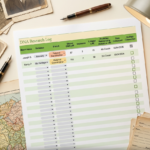
This is where a dedicated system becomes your best friend. In my own research, I use my DNA Research Log to keep track of which relative belongs to which branch.
- The ‘User’ Column: I use this to note exactly whose kit I am looking at – whether it’s mine, my mother’s, or a cousin’s.
- Shared CM: Recording the amount of DNA a match shares with different family members helps narrow down exactly how you are related.
- Notes Section: I use the ‘Insert note’ feature to record who gave permission for the test and where the raw data is backed up.
Using the Research Log for Multiple Kits
If you are managing results for several family members, staying organised is the only way to avoid data overwhelm. The Forever Dear DNA Research Log is designed with this in mind. It includes six pre-set sheets to get you started.
- Customising Your Log: You can easily add more sheets (by duplicating an existing blank sheet) or rename existing ones by right-clicking the sheet name at the bottom of the screen to open the menu.
- Beyond Your Own Kits: These sheets don’t have to be limited to kits you personally manage. They are also incredibly useful for tracking close cousins you’ve found on GEDmatch.
- The Power of One-to-One: By dedicating a sheet to a prominent match on GEDmatch, you can run One-to-One searches between them and other common matches. This helps you map out exactly how a group of people fits into the branches on your tree.
CONSENT
Always keep a simple written or digital record of your relative’s consent. Not only is it ethical, but it ensures that if you ever need to move their data to a new platform (like GEDmatch), you know you have their permission to continue the search.