The countdown is on! With the release of the 1926 Census of Ireland fast approaching, the Irish genealogy community is buzzing. We are finally about to get a glimpse into the lives of our ancestors in the early years of the Irish Free State.
But as any researcher knows, a new census release can be overwhelming. How do you keep track of everyone? How do you bridge the fifteen-year gap between the 1911 records we know so well and the new 1926 data?
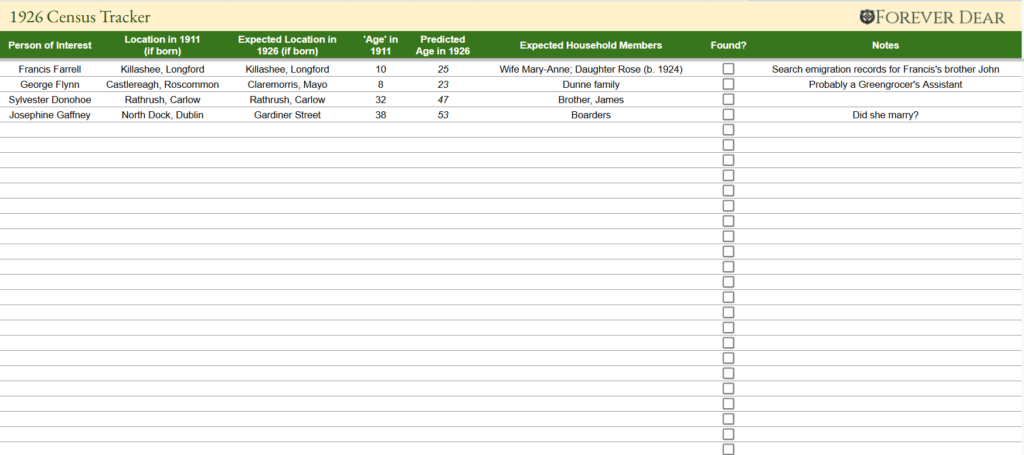
I’ve designed a 1926 Census Research Tracker so you can put in the groundwork before the big day!
You’ll notice that the 1911 Age column in the tracker is listed as ‘Age’ rather than just Age. If you’ve spent any time with the 1901 and 1911 Irish Census records, you’ll know exactly why!
In these records, ages were often reported inconsistently. Between the introduction of the Old Age Pension in 1909 and general memory lapses, a person who was 40 in 1901 might miraculously be 55 by 1911. By putting ‘Age’ in inverted commas, the tracker reminds you that we are working with the reported age from the previous census, which is our primary clue for finding them in 1926, even if it doesn’t perfectly match their birth certificate.
How the Predicted Age Saves You Time
The 1926 Census was taken on the night of 18th April. This creates a gap of exactly 15 years and 16 days since the 1911 Census.
Searching for a “Patrick Barry” who was 16 in 1911 is easy enough, but when you are scrolling through hundreds of search results in 1926, your brain has to do ‘mental maths’ for every single result: 16 plus 15 is… 31. The tracker does the maths for you instantly. By having that ’31’ clearly visible on your worksheet (or printed beside you), your eyes can skim the 1926 search results much faster. It allows you to instantly dismiss the 25-year-olds and 40-year-olds, letting you focus only on the candidates that fit your 1911 data. When you are researching dozens of families, those saved seconds add up to hours of reclaimed research time.
Why Use a Tracker?
Fifteen years is a long time in a family’s history. Children were born, elders passed away, and many families moved from the townlands they had occupied for generations.
I built this tracker to help you do three things ahead of the census release:
- Input your ancestor’s age in 1911, allowing the tracker to automatically predict their age in 1926.
- Instead of just searching for individuals, use the “Expected Household Members” column to list the wives, husbands and children (born between 1911–1926) you expect to find.
- Experience the satisfaction of ticking that “Found” box!
How to Use the Tracker
I wanted to make this as simple as possible so you can spend your time researching, not fiddling with spreadsheets. Here is how to get started – you will need a free Google account to save your own editable copy:
- Click the link below. You will be prompted to make a copy of the document.
- Click the blue Make a copy button. This saves a private, editable version directly to your own Google Drive. No one else can see your data!
- Begin listing your ‘People of Interest’. Look at your 1911 research and fill in their names, locations and ages.
- As you enter an age from 1911, the tracker will automatically predict their age for the 1926 release.
- Use the Expected Household Members column to note children born or spouses married in that fifteen-year gap.
Get Your Free Copy Here
🔗 Open the Forever Dear 1926 Census Tracker
Need a Hand With Your Research?
If you find yourself hitting a ‘brick wall’ between 1911 and 1926, we’re here to help. Whether it’s tracing a family that seems to have vanished, navigating the complex records of the era or documenting your family history, book a free consultation to discuss a way forward.
This will be so useful to us that have not been. Able to gather information from most organisations. and not really able to have the time. or knowledge it takes as it can be hard enough when we have just got in to finding families in ireland from so long ago
Pingback: Missing the North? Why the 1926 Census is 26 Counties Only | ForeverDear