The email has arrived. You’ve clicked the link. You see a map telling you you’re 42% Irish, and a list of 15,000 matches that you’ve never heard of in your life.
It is exciting, a little bit confusing and, if we’re being honest, slightly overwhelming.
Whether you have only just received your results or you have had them sitting in your dashboard for a while, this guide is for you.
It is never too late to take a step back and put a solid system in place. DNA research is a marathon, not a sprint, and the tools we are going to cover will help you cut through the confusion and start making real connections to your ancestors.
I believe that DNA is the most powerful tool we possess in order to bridge the gaps in our paper trail, especially with the 1926 Census giving us new leads to chase. But before you start messaging every 4th cousin on your list, let’s talk about how to handle things like a pro.
🔹My personal DNA Research Log is included (see below) to help you keep track of your DNA matches as you go!🔹
1. Ethnicity Estimates
It’s tempting to spend all your time looking at the ancestral regions. Seeing ‘Munster’ or ‘Connacht’ highlighted brings a wonderful feeling of belonging.
However, remember that ethnicity estimates are exactly that – estimates. They are based on a ‘snapshot in time’. The real gold is in your Match List; you share an ancestor with each and every person on that list.
Read more about ethnicity estimates here – A Beginner’s Guide to DNA Ethnicity Results
2. Key DNA Terms
To navigate your results, you only need to understand three key terms:
- Centimorgans (cM): These are the units of measurement for DNA. The higher the number of cMs, the closer the relationship to your match.
- Shared Matches: This is your most powerful tool. If you know ‘Person A’ is your mother’s cousin, and ‘Person B’ also matches ‘Person A’, you’ve just figured out that ‘Person B’ is almost certainly on your maternal side.
- MRCA (Most Recent Common Ancestor(s)): This is the target. It’s the person (or couple) that you and your match both descend from (e.g., your great-grandparents).
Read more about DNA terms here – DNA Jargon Buster: Making Sense of Your Results
3. Your Family Tree
If I could give you one piece of advice today, it is this – link a public family tree to your DNA results to get the most out of your results. However, here is a helpful tip: it doesn’t have to be your main, working tree.
If you are worried about privacy or your main research is still a work-in-progress, you can simply create a DNA tree containing only your direct ancestors. By listing just the names, birth and death dates, and birth and death locations of your parents, grandparents, and great-grandparents, you provide enough data for the system to work its magic. This simple step is often all it takes to trigger Common Ancestor hints, automatically connecting you to matches who share the same Irish roots.
4. Endogamy
In many Irish communities, particularly in rural areas or coastal islands, families often stayed in the same small parish for centuries. This often leads to endogamy – where the same small pool of ancestors appears in your tree multiple times.
On your match list, endogamy can make a distant 5th cousin appear as a 2nd or 3rd cousin because you have inherited multiple small segments of DNA from several shared ancestors. To avoid getting stuck in a loop, a helpful trick is to focus on your strongest connections first. Try filtering your matches by segment length, focusing on those sharing 15cM (centimorgans) or more. By setting this higher threshold, you filter out the tiny background segments that can be misleading, allowing you to focus on the matches where a clear, genealogical link is much more likely to be found.
5. Search Tips
Don’t try to solve your whole family tree in one afternoon. Use these tips to keep you on track.
- Filter by Close Matches: Focus only on 1st, 2nd, and 3rd cousins for now. 4th-8th cousins are ‘noise’ until you have a more solid foundation.
- Minimum cM: Set your cM filter to a minimum of 15 to sieve out the misleading background segments caused by Endogamy.
- Surname Search: Search for surnames in your family tree. Include spouse’s surnames of siblings of your direct ancestors. For example, your g-grandfather’s sister’s husband’s surname may uncover more information on a g-g-grandparent. Be mindful of spelling variations of villages, towns and townlands.
- Check for Birthplaces: Look for townlands or counties that appear in your matches’ trees which match your own research. If you see ‘Wicklow’ appearing in five different matches, you know where to focus your next search in the 1926 Census! As with surnames, be mindful of spelling variations.
6. Reaching Out
Reaching out to DNA matches can be nerve-wracking, but it is often the key to breaking down those stubborn brick walls or apparent dead ends in your family tree. Whether you are contacting a 2nd cousin or a distant match from a shared parish, the way you frame your message could make all the difference.
Here are my top tips for making a meaningful connection:
1. Keep it Brief and Friendly
Don’t overwhelm your match with your entire family tree in the first message. Aim for a ‘digital hello’ that is easy to read and respond to.
- The Subject Line: Be specific. Instead of ‘DNA Match’, try ‘Potential Match: [Surname] from [Parish/County]’
- The Goal: You aren’t asking for their life story yet; you are just looking for a common ancestor.
2. Lead with Shared Information
Give your match a reason to be curious. Mention the specific details you’ve already noticed:
- “I see we share [number] cM.”
- “It looks like we both have ancestors from Wexford (specifically the [Parish Name] area).”
- “Your tree mentions [Surname], which is a branch I am currently researching.”
3. Ask One Simple Question
End your message with a clear, easy-to-answer question. This significantly increases your chances of getting a reply.
- “Do you happen to know if your [Surname] branch lived in Wexford around the 1880s?”
- “Have you been able to trace your [Surname] line back any further than [Name]?”
4. Be Patient (and Prepared)
Not everyone checks their DNA messages regularly. Some people tested years ago and haven’t logged back in since.
- Log your contact: Use the Forever Dear DNA Research Log (see below) to note down the date you sent the message. This prevents you from accidentally messaging the same person twice, especially if you’ve uploaded your raw data to another company!
- Don’t take silence personally: Genealogy is a hobby for some and a passing curiosity for others. You may never receive a reply.
A Sample Message Template
Subject: Possible DNA Connection – [Surname] from [County], Ireland
Hello [Match Name],
My name is Annie, and I’m a DNA match to you at [number] cMs.
I noticed that we both have roots in [County Wexford], specifically with the [Whelan] family. I am currently trying to bridge the gap between [Ancestor Name, born ????] and their parents.
Do you happen to have any information on this branch of your tree, or would you be open to comparing notes?
Best wishes,
Annie
Documenting Your Matches
It is incredibly helpful, if you find a match, to note down how you think they are related, to avoid forgetting potential connections as your scroll through your matches.
What to Document:
- The Match Name & Site: e.g., Mary123 on Ancestry
- Amount of Shared DNA: e.g., 45 cM across 3 segments
- Shared Ancestral Couple: e.g., Likely descendants of John & Bridget Kelly, Co. Mayo
- Notes on Contact: When did you message them? Did they reply? Did they share a private tree?
I track my matches using my DNA Research Tracker. I developed this tracker to efficiently store all my matches of interest in one place.
Features:
- You can log the match name alongside the specific database where they were found (such as Ancestry or MyHeritage).
- Dedicated columns allow you to record the amount of shared DNA (cM), the number of segments, and the longest segment (cM).
- Track common locations, such as townlands, DEDs or parishes.
- Document the likely or confirmed Most Recent Common Ancestors (MRCA) and the number of generations between you and the match.
- A status column enables you to keep track of your current stage of research for every individual match.
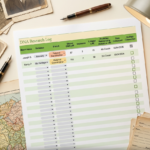
Check your inbox once you have downloaded the Research Log, you will receive tips on how to use it.
If you’re worried that your 1800s ancestors are too far back for DNA to find, think again. By finding a 3rd cousin today, you are finding the living proof of a couple who lived in Ireland during the Famine or the Land Wars.
Need a hand de-coding your list? If your match list looks like a puzzle with missing pieces, I can help. From chromosome mapping to building the paper trail and documented family history to match your DNA, Forever Dear is here to turn those centimorgans into ancestors.