One of the most common frustrations for anyone starting their Irish genealogy journey is the ‘address’ problem. You find a record that mentions a Barony, another that lists a PLU, and a third that talks about a DED. It feels like Ireland was divided a dozen different ways – and the truth is, it was!
Understanding these layers isn’t just for map lovers; it is the secret key to finding your ancestors. If you don’t know your Poor Law Union, you might never find a birth cert. If you don’t know your DED, Census returns can remain a mystery.
Why are there so many divisions?
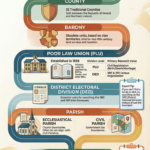
Historically, Ireland’s land was organised for different purposes: some for ancient clan territories (Baronies), some for the church (Parishes) and some for the British taxman (Civil Parishes and Townlands).
To help you navigate this, I’ve broken down the hierarchy from the largest area to the smallest ancestral plot.
The Big Picture: Provinces and Counties
We all know the four Provinces (Leinster, Munster, Connacht, and Ulster) and the 32 traditional counties. These are your ‘compass points’. While they are essential for broad searches, they are usually too large to help you find a specific family home.
The Administrative Layer: Baronies and PLUs
- Baronies: These are ancient land units. While obsolete today, they are vital for navigating mid-19th-century land surveys.
- Poor Law Unions (PLU): If your ancestor was born after 1864, the PLU is your best friend. These districts were centered around market towns and became the administrative units for Civil Registration (Births, Deaths, and Marriages).
The Census Key: DEDs
The District Electoral Division (DED) is a subdivision of the PLU. If you are searching the 1901 or 1911 Census, or the newly released 1926 Census, you need to know the DED to narrow your search effectively.
The “X Marks the Spot”: Parishes and Townlands
- The Parish Puzzle: Always remember there is a difference between a Civil Parish (used for government records) and an Ecclesiastical Parish (used for Church records). They don’t always share the same borders!
- Townlands: This is the ‘Holy Grail’ of Irish research. There are over 60,000 townlands in Ireland. Finding your family’s townland is more than just identifying a coordinate on a map; it is about finally locating the heart of your heritage.
Download Your Free Guide
Irish Land Divisions can be confusing when you’re staring at a stack of records, I’ve created a visual guide for you to download.
Need a Helping Hand?
If you’ve identified the County but keep hitting a brick wall when it comes to the Townland or Parish, I’m here to help. ForeverDear specialises in bringing your family history to life.